Address
251 Little Falls Drive, Wilmington, DE 19808, United States




Ever feel lost when your child asks for homework help, and you’re not sure of the answer yourself? You’re not alone. With AI tools like ChatGPT entering homes, parents now have a smart assistant at their fingertips. In this guide, we’ll explore how ChatGPT for homework help can genuinely support your child’s learning, and how to use it the right way. Let’s make tech work for your family, not against it.
Table of Contents
Why parents are exploring AI for homework help
Modern parenting means navigating a world where artificial intelligence is becoming part of daily life, including schoolwork. With busy schedules and a growing academic load, many parents are turning to AI-powered tools like ChatGPT to help their children complete homework faster, smarter, and more independently. But is this the future of learning or a shortcut to avoid effort?
What is ChatGPT and how does it work?
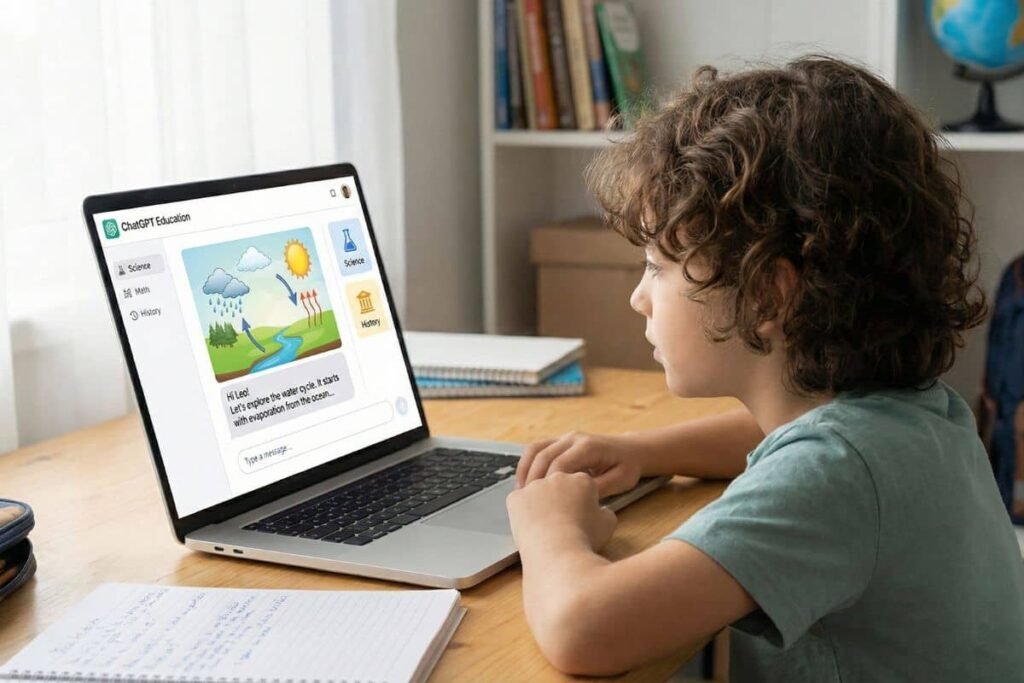
ChatGPT is a language model developed by OpenAI that generates human-like responses to text-based prompts. It can answer questions, summarize information, explain concepts, and even help brainstorm ideas, all in real time. For kids doing homework, this means having a 24/7 tutor-like assistant that never tires or gets impatient.
Benefits of ChatGPT for students’ learning
Instant answers with contextual understanding
Unlike search engines that throw dozens of links at users, ChatGPT delivers direct, conversational responses. When your child asks, “Why did the Roman Empire fall?”, they won’t just get a list of articles, they’ll get a concise explanation tailored to their age level.
ChatGPT for homework help encouraging independent thinking
ChatGPT doesn’t just hand out answers. When prompted right, it encourages critical thinking by asking questions back or offering multiple perspectives. This makes it a valuable learning partner when used wisely.
Common concerns parents have about ChatGPT
Accuracy and misinformation risks
Although ChatGPT is powerful, it’s not perfect. It can “hallucinate” a term for when AI makes things up. If your child blindly trusts the responses, they might learn incorrect facts or outdated information.
Screen time and overreliance
Too much reliance on AI tools can limit a child’s effort and deeper learning. Like any technology, ChatGPT for homework help should be part of a balanced academic routine, not a crutch for avoiding hard thinking.
How to use ChatGPT effectively with your child
Setting clear rules and homework boundaries
Establish when and how ChatGPT can be used. For example, allow it for brainstorming or summarizing, but not for copying full answers. This sets healthy limits and keeps the child in charge of their learning.
Creating guided prompts together
Help your child craft better questions. While using ChatGPT for homework help, and instead of asking “What is a cell?”, try “Can you explain what a cell does in the human body in simple terms?” This builds both curiosity and digital literacy.
Example: using ChatGPT for math homework step by step
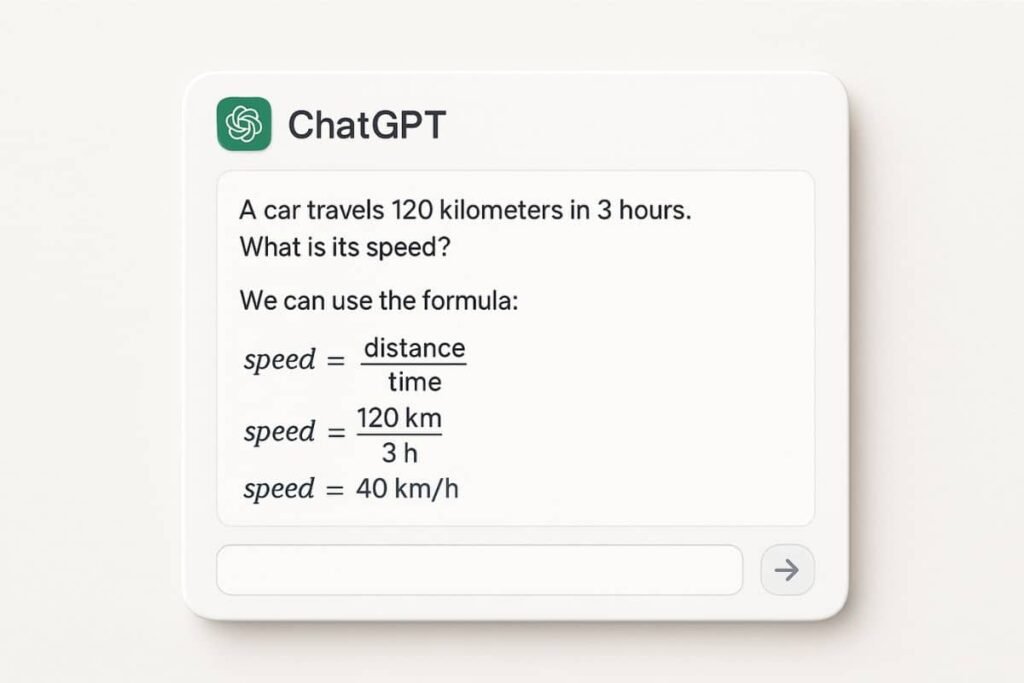
Let’s say your child is working on a math word problem: “If a train travels 60 miles in 1.5 hours, what is its average speed?” Here’s how you can guide them to use ChatGPT:
- Prompt ChatGPT:
Can you explain how to calculate average speed from distance and time? - ChatGPT responds with a clear explanation: “To find average speed, divide the distance by time: Speed = Distance / Time.”
- Your child inputs the specific problem:
If a train goes 60 miles in 1.5 hours, what’s the speed? - ChatGPT shows the calculation: “60 divided by 1.5 equals 40. The train’s average speed is 40 miles per hour.”
This step-by-step guidance helps your child understand the method of using ChatGPT for homework help, not just the answer. It’s a way to reinforce classroom learning in a personalized, patient format.
Another real-life scenario involves writing assignments. Suppose your child is asked to write a short essay on climate change. Together, you can ask ChatGPT: Can you help outline a short essay about climate change for a 6th grader? ChatGPT might reply with a structure: introduction, three main points (what climate change is, why it’s a problem, and how we can help), and a conclusion. From there, your child can expand on each point with guidance, turning an overwhelming assignment into a manageable task. You can even go further by asking: Can you help write a sentence for each point? but always ensure your child rephrases and understands the ideas before submitting the work.
Red flags: when ChatGPT isn’t helping
Signs of misuse or dependency
If your child rushes through homework with ChatGPT’s help and can’t explain the answers, it’s a sign of overdependence. Learning is about process, not just getting things done.
What to do if it replaces real learning
Revisit the purpose of the assignment. If ChatGPT is replacing thinking, introduce reflection questions or follow-up discussions to ensure comprehension.
Balancing AI tools with human support
ChatGPT as a supplement, not a substitute
Think of ChatGPT as an academic training wheel. It helps with the ride but shouldn’t take over the steering. Encourage your child to use it as a guide, not the only source of truth.
Involving teachers in the conversation
Some schools have strict policies about AI. Talk with teachers to understand what’s allowed and collaborate on responsible use. This builds trust and consistency between home and school.
For more insights on AI education tools, explore our guides on AI learning tools for kids and AI learning for kids. You can also check out ChatGPT by OpenAI to learn more about how it works.
ChatGPT for homework help can be a game-changer and a real time saver, if used wisely. From solving math problems step-by-step to outlining essays, it’s a tool that can help your child think more clearly and learn more effectively. As a parent, your role is to guide the use of this technology, not replace effort with shortcuts. Start small, stay involved, and make homework a little less stressful for both of you.